What To Wear On Safari In Kenya: The Packing List That Survives The Mara
Nearly everyone packs for equatorial heat and then spends the first morning shivering in an open vehicle at ten degrees. Here is what to actually wear on a Kenya safari, which colours to leave at home and why, and the packing list that survives Mara dust and a 15 kg baggage limit.
Booking Choice: Pack around the activities you will actually do: vehicle game drives, a dawn balloon flight, or a hosted village visit. Explore Three-Day Shared Land Cruiser Safari
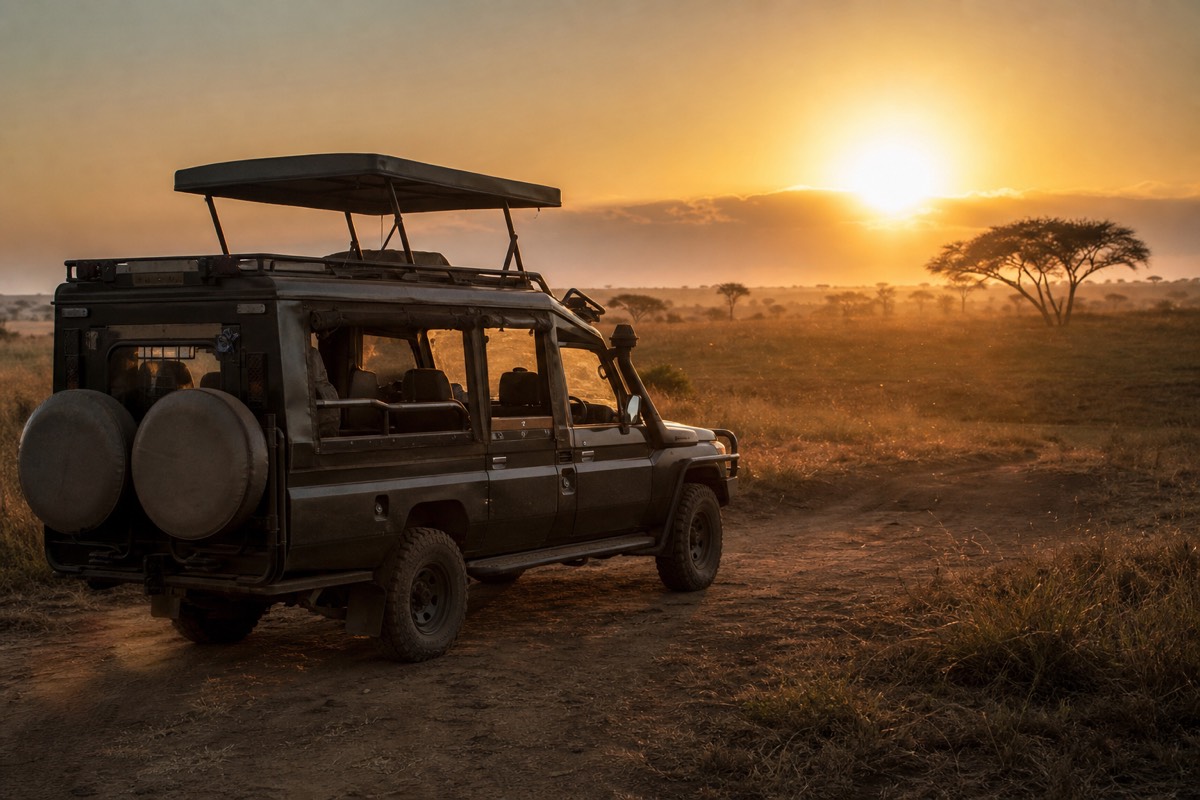
The single most common packing mistake on a Kenya safari is not a missing item. It is a wrong assumption about temperature. People book a trip to the equator, pack for the equator, and then find themselves in an open-roofed Land Cruiser at six in the morning, doing forty kilometres an hour into the wind, at a temperature our own season guides put at 10 to 14 degrees Celsius. By eleven the same day it is close to thirty.
At A Glance: Keep the warm layer, choose the experience, then check its pickup and baggage requirements before buying more gear. Explore Three-Day Shared Land Cruiser Safari
Everything below is built around that swing, plus the second thing nobody warns you about, which is dust. A dirt track in the dry season puts a fine red film on every surface in the vehicle including you. Pack for the swing and the dust and the rest of the list mostly writes itself.
One Mara day, three different climates
Temperature bands are the figures used across this site's season guides: mornings of 10 to 14 C, especially June to August, against daytime highs of 25 to 29 C. Treat them as planning allowances, not a forecast.
What Should You Actually Wear On A Kenya Safari?
Neutral, breathable, long, and layered. Khaki, olive, tan and stone in cotton or a light synthetic, long sleeves and long trousers as the default, a genuine fleece or insulated jacket for the dawn drive, a wide-brimmed hat, and closed shoes. Nothing technical is required. Nothing white, nothing camouflage, nothing you would be upset to see permanently dusty.
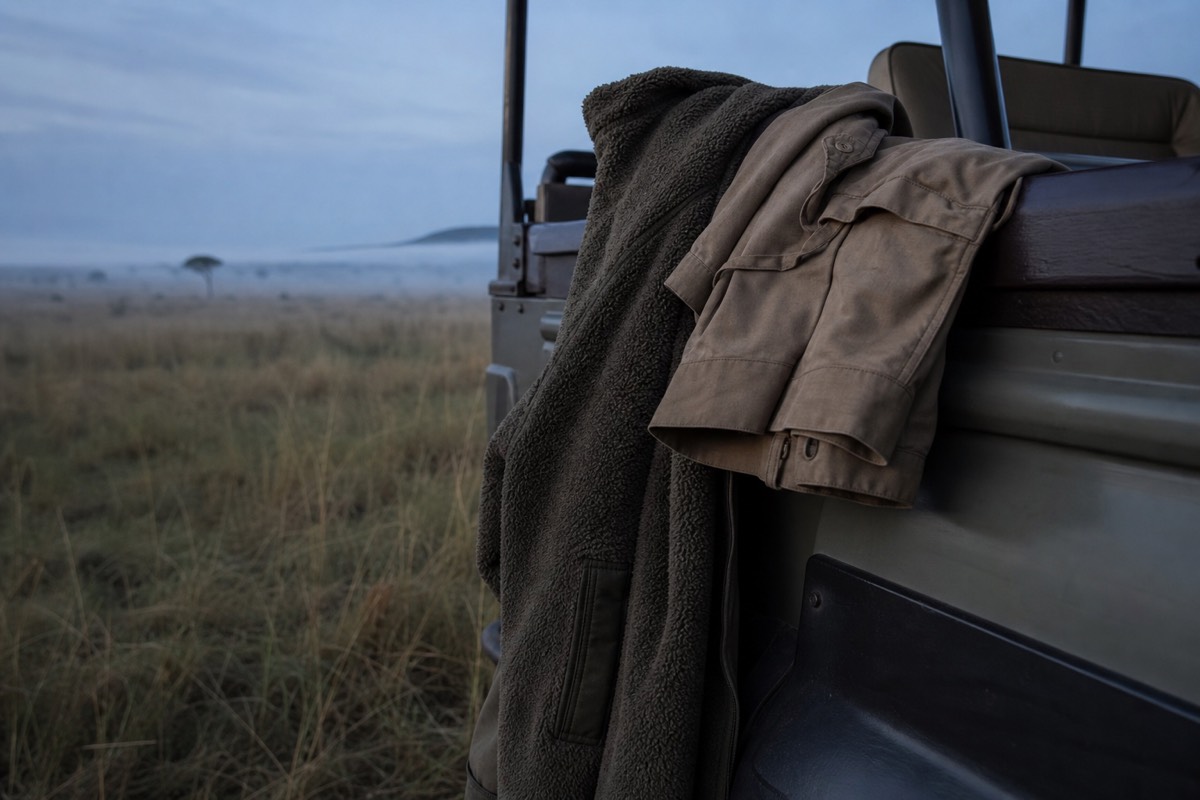
Long sleeves and long trousers do three jobs at once and that is why they beat shorts even in the heat: sun protection at altitude, mosquito cover at dawn and dusk, and a barrier against the thorn scrub if you get out of the vehicle. Roll the sleeves when it warms up. Convertible zip-off trousers are popular and perfectly fine, though a plain pair of light trousers and a pair of shorts for camp does the same job without looking like an expedition.
Fabric matters more than brand. Cotton is comfortable and breathes but takes a long time to dry, which is a real consideration in the rainy months. Light synthetics dry overnight and pack small. Linen creases into a state that Mara dust then fixes permanently. Merino is the quiet winner for the top layer because it can be worn several days without smelling, which is the actual constraint when you are travelling with 15 kilos.
The one item people under-buy is the warm layer. A thin windproof shell is not enough on its own. A proper fleece, or a light down jacket that packs to nothing, is what makes the first ninety minutes of a morning drive enjoyable rather than endured, and those ninety minutes are when the predators are moving. Our page on planning a Maasai Mara safari in the right order makes the same point from the itinerary side: the dawn window is the trip, so dress to be present in it.
Which Colors Are Not To Wear On Safari?
Dark blue and black, because tsetse flies are strongly attracted to those colours and are trapped using blue and black cloth. White, because Mara dust covers it inside an hour. Camouflage, because military-pattern clothing is illegal for civilians in Kenya. Bright saturated colours are a soft no at close range, on contrast grounds rather than any rule.
The blue and black advice is the only colour rule on this list with published science behind it, and it is worth getting the detail right because the internet garbles it constantly. Tsetse control programmes use blue and black cloth targets because the flies are drawn to blue and then land preferentially on black. The standard explanation given by tsetse researchers is that the flies are hunting for shaded resting places during the day, and blue reads to them like the bluish tinge of a shadow. Attraction rises in the order yellow, green, red, blue. So red, contrary to what a lot of packing lists imply, is not the safest colour in tsetse terms. It simply is not the worst one.
Where does that leave you in practice? Most of the Maasai Mara is open grassland rather than the dense riverine thicket tsetse prefer, and travellers go whole trips without meeting one. But the bite is unpleasant and the mitigation costs you nothing, so leave the navy fleece and the black hoodie at home and take an olive one instead.
The white rule is pure practicality. The camouflage rule is legal, and it applies to civilians across Kenya, so leave anything camo-patterned out of the bag entirely, including a child's backpack. Red, worth saying clearly since it comes up constantly, is culturally fine everywhere in Kenya and worn daily by the Maasai. We answer that one properly in the guide to Maasai culture and village life.
| Colour | Verdict | Reason |
|---|---|---|
| Khaki, olive, tan, stone, sage | The default | Low contrast against dry grass, hides dust, reads as neutral in every setting from a game drive to a village |
| Dark blue, navy, black | Avoid | Tsetse flies are drawn to blue and land on black; these are the colours their traps are made from |
| White, cream | Avoid for drives | Shows Mara dust within the first hour. Fine for camp in the evening |
| Camouflage, any pattern | Illegal | Military-pattern clothing is restricted for civilians in Kenya. Confiscation at the airport is a real outcome |
| Bright red, hot pink, electric blue | Fine culturally, unhelpful at close range | High-contrast blocks moving above the roofline are more visible to animals. No rule against it |
| Grey, brown, faded denim | Fine | Neutral enough, though denim is heavy, slow to dry and hot in the middle of the day |
How Cold Does A 6am Game Drive Really Get?
Cold enough that our own season pages tell people to expect 10 to 14 degrees Celsius at dawn, dropping to the lower end from June through August, against daytime highs of 25 to 29. Add an open roof and a moving vehicle and the effective temperature on your hands and face is lower still. Breath is visible on plenty of July mornings.
The Mara sits well above sea level, which is what people miss. Altitude, not latitude, sets the morning temperature, and the same altitude is why the midday sun burns faster than the thermometer suggests. That combination is the entire argument for layers rather than a single warm coat: you want to be able to strip from four layers down to one across about three hours without stopping the vehicle.
The other seasonal variable is water. The long rains run March to May and peak in April, which our season research puts at around 121 millimetres across roughly 22 rainy days. The short rains in November and December are lighter and tend to arrive as an afternoon burst rather than an all-day soak. In either window you want a packable rain shell and a dry bag or two for camera gear, and you want fast-drying fabric rather than cotton. If you are still choosing dates, our month-by-month guide to the Mara lays out what each month actually delivers.
| Part of the day | What you are wearing | What you are carrying |
|---|---|---|
| 5.30am, coffee at camp | Base layer, shirt, fleece, long trousers, socks, closed shoes | Headtorch, because camp paths are unlit |
| 6.00 to 8.00am, first drive | All of the above plus a windproof shell, a buff or scarf, and a warm hat | Binoculars, camera, gloves if you feel the cold |
| 8.00 to 9.30am | Shell and hat off, fleece unzipped | Sunglasses on as soon as the light comes up |
| 9.30am to 3.30pm, camp break | One light layer, shorts if you like, sun hat | SPF 50, lip balm, water |
| 3.30 to 6.00pm, second drive | Long sleeves back on, fleece on the seat beside you | Insect repellent from about 5pm |
| 6.00pm, sundowner and the drive back | Fleece on again, long trousers, socks and closed shoes | Headtorch, repellent, a warm layer you will genuinely want |
What Actually Goes In The Bag?
Less than you think, and in soft luggage. Three or four shirts, two pairs of trousers, one fleece, one shell, one hat, one pair of closed shoes, one pair of camp sandals, and the small kit. Camps do laundry, most of them daily, which is why the seven-day list is barely longer than the three-day list.
The quantities below assume you are on a road safari from Nairobi with a camp that washes clothes. Almost every one of our Nairobi-departing Mara safari tours fits that description, from the five-day Mara, Nakuru and Naivasha small-group tour through to the longer private circuits. If you are moving camp every night, add one shirt and take one fewer pair of trousers, because trousers survive multiple wears far better than shirts do.
| Item | 3-day trip | 7-day trip | Note |
|---|---|---|---|
| Long-sleeve shirts, neutral | 2 | 3 | Merino or light synthetic. One can be worn two days |
| T-shirts | 2 | 3 | For camp and the middle of the day |
| Long trousers | 2 | 2 | Trousers get dusty, not dirty. Two is genuinely enough |
| Shorts | 1 | 1 | Camp only. Not for drives, and not for a homestead visit |
| Fleece or light down jacket | 1 | 1 | The single most under-packed item on this list |
| Windproof or rain shell | 1 | 1 | Packable. Essential March to May and November to December |
| Wide-brim hat | 1 | 1 | With a chin cord, or it leaves the vehicle at speed |
| Closed walking shoes | 1 | 1 | Trail shoes are plenty. Heavy boots are unnecessary unless you are walking daily |
| Sandals or camp shoes | 1 | 1 | For the middle of the day and the shower block |
| Underwear and socks | 4 | 5 | Laundry closes the gap |
| Swimwear | Optional | 1 | Many mid-range and luxury lodges have a pool |
| Buff, scarf or neck gaiter | 1 | 1 | Dust on the drive, cold at dawn. Does both jobs |
How Strict Is The Baggage Limit If You Fly To The Mara?
Strict, and it is soft-sided only. The scheduled light aircraft that run from Wilson Airport in Nairobi to the Mara airstrips work to a total allowance in the region of 15 kilos per passenger, and our own transport guide flags travellers getting hit with overweight charges at the Wilson check-in desk. A rigid wheeled suitcase will not fit the hold shape regardless of weight.
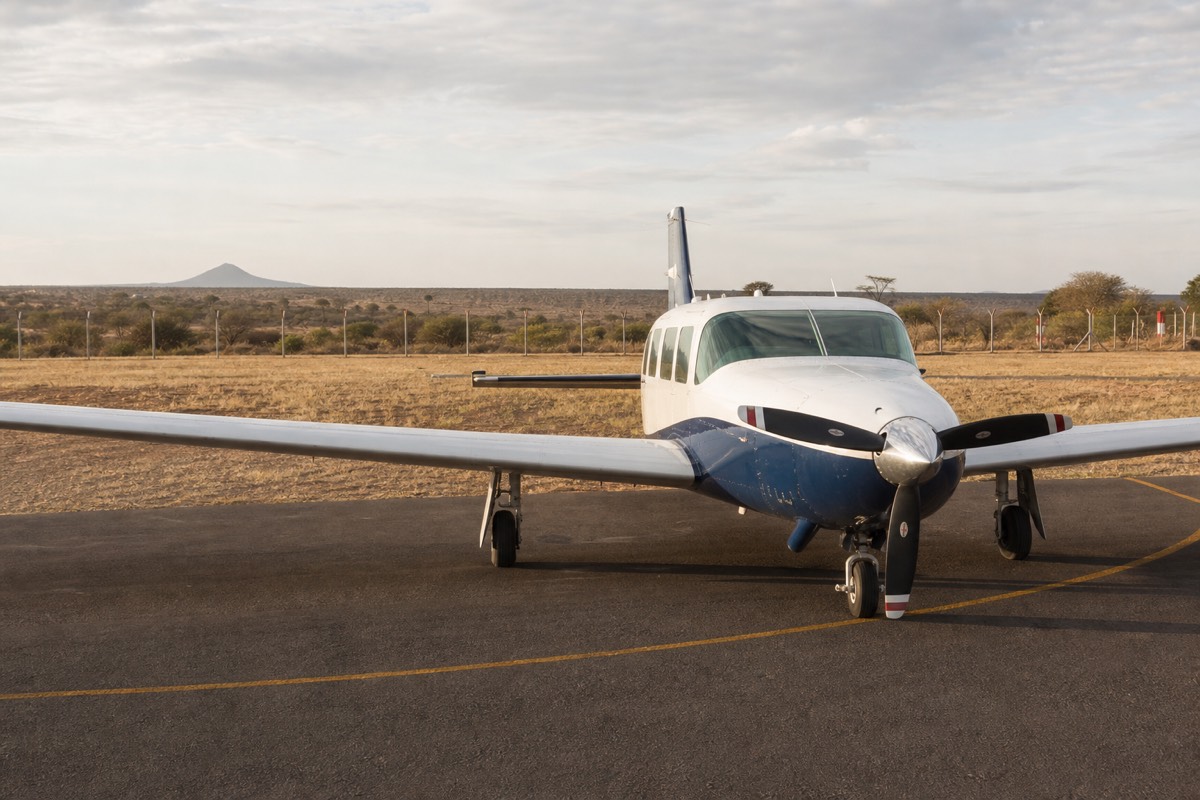
This catches people out because it is a different regime from the international flight that brought them to Kenya. Small propeller aircraft are weight and volume constrained in a way jets are not, so allowances are low, they usually include your hand luggage, and the bag has to be soft enough to be squeezed into an irregular hold. A duffel is the right answer. Camps in Nairobi will normally store the hard case you flew in with while you are in the bush, and that arrangement is worth confirming when you book rather than discovering on the morning.
If you are driving instead, none of this applies and you can take whatever fits in the vehicle, which is one of the quiet advantages of the road option on a short trip. The full comparison of flying against driving, including what each actually costs, sits in our guide to getting from Nairobi to the Maasai Mara.
| Road safari from Nairobi | Light aircraft from Wilson | |
|---|---|---|
| Bag type | Anything that fits the vehicle | Soft duffel only. No rigid wheeled cases |
| Weight | Practical limit only | Around 15 kg total per passenger, hand luggage usually included |
| Overweight consequence | None | Charges applied at the check-in desk, or the bag travels on a later flight |
| Camera gear | Take the long lens | Long lens counts toward the same allowance. Wear the heavy body around your neck |
| Journey time | Five to six hours each way, roughly 270 km | About 45 minutes |
| What to leave in Nairobi | Nothing | City clothes, hard case, anything not needed in the bush |
What Do Women Most Often Ask About, And What Actually Works?
Three questions come up repeatedly: whether trousers are required, what to do about a bra strap under a day of sun, and how modest to be off the reserve. Short version: trousers are strongly preferred but not compulsory, a light long-sleeve overshirt solves the sun problem better than sunscreen alone, and dressing modestly outside camp is a courtesy that costs nothing.
Inside a camp or lodge you can wear more or less what you like. On a game drive, long trousers beat a skirt or dress on every axis: thorn scrub, dust, insects, and the practicalities of standing up under an open roof in a moving vehicle. A midi skirt over leggings works for people who dislike trousers and is common enough in camps. For sun, a loose long-sleeve overshirt in a light neutral is the single most useful garment a woman can pack for the Mara, because it goes on and off over everything else all day.
Off the reserve, in Narok town or on a homestead visit, cover shoulders and knees. Rural Kenya is more conservative than a safari camp, and the difference in how you are received is noticeable. This matters particularly if a cultural visit is on your itinerary, as it is on many of the tours we work with. Underwired bras and the dust are a genuine combination to think about on a long drive; several travellers we have heard from switch to a soft sports bra for the vehicle and change at camp. Take a hair tie, take dry shampoo, and take more lip balm than you think, because the air is dry and the wind is constant.
Which Shoes, And Do You Need Boots?
Closed, broken-in, low. A trail shoe or a light walking shoe covers everything a normal safari asks of you, because you spend most of the day sitting. Heavy hiking boots are dead weight unless you are doing walking safaris daily, and open sandals belong at camp rather than in the vehicle.
The one context where a real boot earns its place is a conservancy stay with a walking programme. Walking safaris are not permitted inside the national reserve and are one of the things the private conservancies exist to offer, along with night drives and off-road driving. If your itinerary includes those, take ankle support and gaiters if you own them; if it does not, take the trail shoe and use the weight allowance on a longer lens. We go through which areas allow what in our guide to the Mara Triangle and the private conservancies.
Socks matter more than people expect. Dust works into everything and a thin ankle sock leaves a red tidemark by day two. Mid-height socks in a dark neutral, three or four pairs, and you stop thinking about it.
What Do You Wear For A Balloon Morning Or A Homestead Visit?
For the balloon: the warmest version of your dawn kit, because you are launching in the dark and standing around before the flight. For a homestead: covered shoulders and knees, neutral colours, and shoes you do not mind getting dusty. Neither needs anything you were not already packing.
Balloon mornings start earlier than a normal game drive and involve standing outside a basket in the coldest part of the night while the envelope inflates. Take the fleece, the hat and the buff, and take gloves if your hands feel the cold, because you will want them for the camera. Flights over the Mara are capped at 16 passengers per basket and fill weeks ahead in the busy months, so this is a booking decision as much as a packing one. The sunrise balloon flight with a champagne bush breakfast is the standard version, and our page on the Maasai Mara balloon safari covers how the morning runs end to end.
For a cultural visit, the guidance is the same guidance you would apply to any village anywhere: cover up, ask before photographing, and do not turn up straight off a pool deck. Several itineraries build one in, including the three-day private Mara safari staying at Sopa Lodge, which offers an optional visit to a homestead in the Ololaimutiek area.
What Is In The Small Kit That Saves The Trip?
Repellent with DEET, a headtorch, high-factor sun cream, lip balm, rehydration salts, a basic first-aid kit, and enough small-denomination cash for tips and a homestead fee. Camps stock very little of this, and the nearest shop is hours away.
The Mara is a malaria area and personal protection is your responsibility rather than the camp's, which is a point our page on safety in the Maasai Mara makes plainly. Prophylaxis is a conversation to have with a doctor well before departure. Repellent, long sleeves after dusk and a treated net where the camp provides one are the practical layers on top of that.
| Item | Why it earns its space |
|---|---|
| DEET-based repellent | Applied from late afternoon. The camp will not have any if you forget |
| Headtorch | Camp paths are unlit, tents have no bedside switch, and staff escort you after dark for a reason |
| SPF 50 and a lip balm with SPF | High-altitude sun through an open roof burns faster than the temperature suggests |
| Rehydration salts | Long dusty days, early starts, and less water than you meant to drink |
| Basic first aid, plus any prescription medicine in its original box | The nearest pharmacy is hours away by road |
| Wet wipes and hand sanitiser | The single highest-value item per gram on a dusty road safari |
| Small-denomination US dollars and Kenyan shillings | Guide and staff tips, a homestead fee, drinks at camps that do not take cards |
| Universal adapter and a power bank | Type G sockets, and camp generators that run on a schedule rather than around the clock |
| Dry bag or two large zip bags | Dust in the dry season, rain in the wet one. Cameras need both |
Which Camera And Optics Actually Earn Their Weight?
Binoculars first, long lens second, everything else optional. A pair of 8x42 binoculars improves every single sighting including the ones your phone cannot reach. For photographs, 400mm is the useful floor on a crop sensor and the difference between a recognisable lion and a good lion picture.
Most travellers over-invest in bodies and under-invest in reach. Animals in the Mara are often genuinely close, but the shot you will want is the one across the river or on the far side of a thicket. A superzoom bridge camera at 600mm equivalent frequently outperforms an expensive camera with a short lens for exactly that reason. Bring more memory cards than you think and a way to charge in a vehicle, because generator hours at camp are limited.
Dust is the real enemy of camera gear here. Change lenses as little as possible, keep the body in a bag between sightings rather than on the seat, and take a blower rather than trusting a cloth. Serious photographers should look at itineraries built for the job, such as the ten-day Maasai Mara photographer safari, where the vehicle and the timing are arranged around light rather than around a schedule. If you are extending the trip to the coast afterwards on something like the nine-day safari and beach holiday from Nairobi, add swimwear and a light waterproof bag and change nothing else.
What Do First-timers Over-pack, And What Do They Forget?
They over-pack clothing and under-pack warmth, batteries and small cash. Almost nobody uses half of what they bring, and almost everybody wishes they had one more warm layer on the first morning and a headtorch on the first night.
| Over-packed | Why it stays in the bag | Forgotten | Why it hurts |
|---|---|---|---|
| Six or seven outfits | Camps do laundry and you re-wear trousers anyway | A real fleece | The dawn drive is the best part of the day and you spend it cold |
| Heavy hiking boots | You are sitting for most of the day | Headtorch | Unlit camp paths, and nothing to read by after the generator goes off |
| Full-size toiletries | Weight against a 15 kg allowance | Small-denomination cash | Tips, homestead fees and camp bars that do not take cards |
| A hard suitcase | Will not fit a light aircraft hold at any weight | Spare camera battery and cards | Charging windows at camp are short |
| Formal clothes | No safari camp expects them | Binoculars | The cheapest upgrade to every sighting on the trip |
| Bright and white clothing | Dust, and contrast at close range | Lip balm and rehydration salts | Dry wind, altitude, long days |
Can You Do Laundry, And How Light Can You Really Go?
Most camps and lodges offer same-day laundry, often included at the mid-range level and above, sometimes with the caveat that underwear is not handled for cultural reasons. Plan on three or four days of clothing regardless of trip length, and a genuinely light traveller can do the Mara out of a 40-litre duffel.
Two things to know. Laundry is usually washed by hand and dried in the sun, so it comes back the same day if it goes in early and the next day if it goes in after lunch. And several camps ask guests to wash their own underwear, providing soap for the purpose, which is a normal arrangement across East Africa rather than an oversight. A small tube of travel wash and a length of cord takes care of it.
If you want to see how the whole trip fits together before you start buying gear, our step-by-step page on planning a Maasai Mara safari covers the sequence of decisions, and the budget against luxury comparison is a useful reality check on what your camp will and will not provide. Pack for the dawn, not the equator, and the rest of it takes care of itself.