The Maasai Tribe: Culture, Village Life And How To Visit Well
The Mara is named for the people who grazed it long before it was a reserve. Here is who the Maasai actually are, what the red cloth, the beads and the jumping mean, and how to spend an hour in someone's homestead without turning it into a performance.
Booking Choice: Choose a local village visit if you are already in the Mara, or a longer itinerary with a documented cultural component. Neither should be confused with admission to a private ceremony. Explore Maasai Village Cultural Visit in Maasai Mara
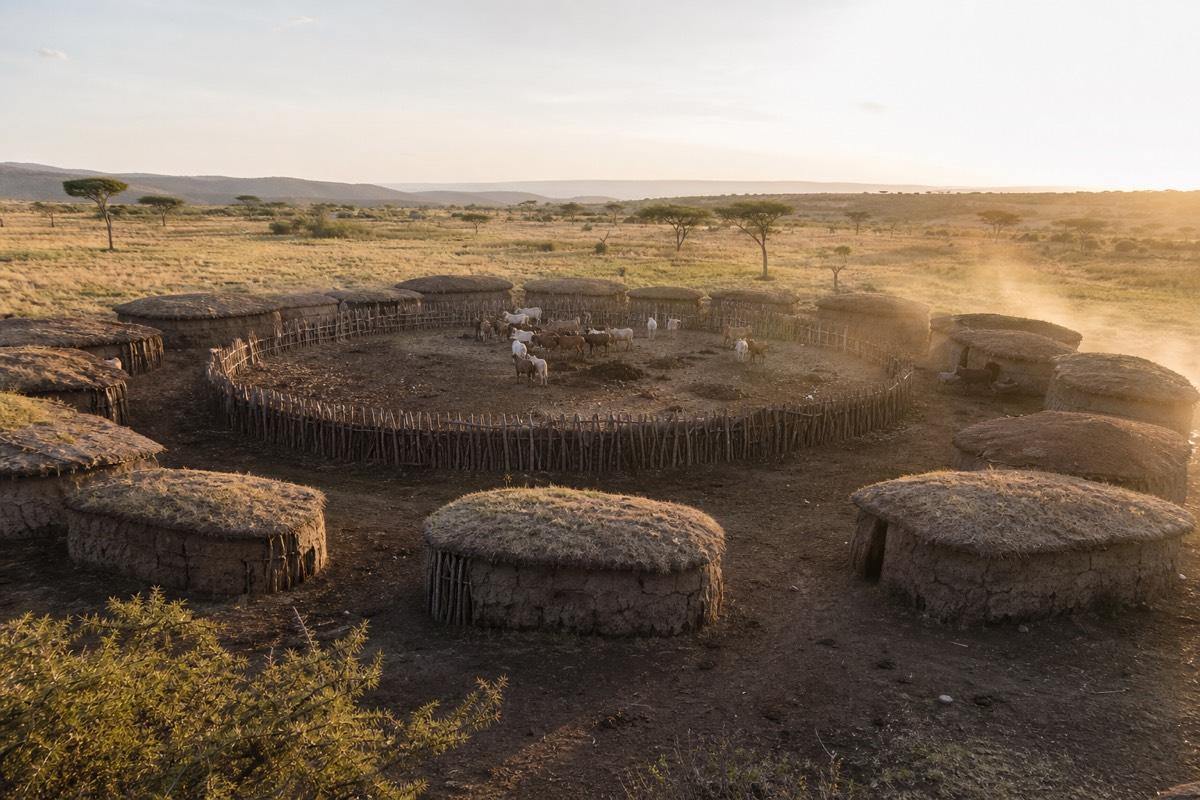
Most safari itineraries treat the Maasai as a scheduled stop: forty minutes on the way out of the reserve, a dance, a photograph, a beaded bracelet. That framing gets the geography backwards. The reserve is named for the people who grazed it long before it was gazetted, the conservancies ringing it are leased from Maasai families who hold the title deeds, and the man reading zebra body language from the driver's seat almost certainly grew up moving cattle across the same plain.
At A Glance: The local Mara village visit is the direct cultural starting point; the three-day bush-walk itinerary adds conservation context and a boma visit. Explore Maasai Village Cultural Visit in Maasai Mara
This is the background our team wishes every traveller had before that hour in the homestead. Who the Maasai are, how the age-set system works, what the jumping actually is and where it belongs, why the cloth is red, what the beadwork says, and how to be a guest without turning a family's compound into a stage. Where a claim is contested, or where we could not source the mechanism behind a story people repeat confidently, we say so instead of passing it along.
The Maasai age ladder, in one line
Ceremony names and the 15 to 30 age band follow UNESCO's 2018 intangible-heritage inscription of Enkipaata, Eunoto and Olng'esherr. Ages are approximate and vary by section and family.
Who Are The Maasai, And Where Do They Actually Live?
The Maasai are a Nilotic, cattle-keeping people of southern Kenya and northern Tanzania who speak Maa. Kenya's 2019 national census recorded 1,189,522 Maasai, about 2.5 percent of the country, concentrated in Narok and Kajiado counties. The Maasai Mara sits inside that territory rather than beside it, which is why Maasai land questions and Mara tourism questions are the same question.
Maa is an Eastern Nilotic language, closely related to what the Samburu speak further north and the Chamus around Lake Baringo. The Maasai moved south down the Rift Valley over several centuries, and by the middle of the nineteenth century their grazing range ran from the highlands north of Nairobi deep into what is now central Tanzania. Two colonial-era treaties, in 1904 and 1911, pushed them off the central Rift highlands and onto reserves in the south. Almost every land dispute you will read about around the Mara today traces back through that dispossession, then through the group-ranch era of the 1960s onward, and finally through the subdivision of those group ranches into individual family parcels. The reason a conservancy can exist at all is that thousands of Maasai families ended up holding individual title to strips of grassland that wildlife needs to move across.
On the Tanzanian side the community is spread across the Arusha, Manyara, Simiyu and Ngorongoro areas. The border between the two countries runs straight through the middle of a single ecosystem and a single people, which is a good thing to hold in mind if you are also weighing up the Maasai Mara against the Serengeti for your trip.
One small thing that saves confusion at the booking stage: you will see both spellings. "Maasai" is the spelling the community itself uses, closer to how the word sounds in Maa. "Masai" is the older colonial rendering, and it is baked into airline codes, park signage and a great many booking systems, which is why the same reserve appears as both Maasai Mara and Masai Mara on tour listings.
| Word you will hear | What it actually refers to |
|---|---|
| Maasai | The people. The community's own preferred spelling in both Kenya and Tanzania. |
| Masai | The older colonial-era spelling. Still standard in booking systems and on road signs, which is why "Masai Mara" appears on so many listings. |
| Maa | The language. Eastern Nilotic, closely related to Samburu. |
| Mara | Roughly "spotted" or "dappled" in Maa, describing how the plain reads from a distance: acacia, scrub, and the shadows of cloud moving across grass. |
| Enkai (Ngai) | God, and also the sky and the rain. The same word covers all three, which tells you something about a herding people's theology. |
| Il-murran (moran) | The warrior age-grade, and the men in it. |
| Enkang / boma | A family homestead: a ring of houses inside a thorn fence, livestock in the middle at night. |
| Manyatta | Strictly, a warriors' settlement, not an ordinary village. Tour copy uses it loosely for any homestead. |
| Inkajijik | The houses themselves, built by the women of the homestead. |
What Holds Maasai Society Together?
Age-sets. Every Maasai man belongs to a named generation that moves through life as a unit, promoted together by ceremony rather than by birthday. Three of those ceremonies, Enkipaata, Eunoto and Olng'esherr, were inscribed by UNESCO in 2018 as intangible cultural heritage. Understanding this ladder explains almost everything else, including the jumping.
An age-set is not an age bracket. It is a cohort with a name, initiated together over a period of years, and it stays a cohort for life. Men of the same set call each other by set-mate terms, owe each other hospitality, and are promoted as a block. The promotions are the ceremonies. UNESCO's 2018 inscription describes the sequence plainly: Enkipaata is the induction of boys that opens the way to initiation, Eunoto is the shaving of the morans that moves them toward adulthood, and Olng'esherr is the meat-eating ceremony that closes moranism altogether. The listing puts the men involved between roughly 15 and 30, and it is candid about the pressure the whole system is under, naming the shift toward crop agriculture, land tenure reform and the effect of a changing climate on cattle survival as reasons the rites are performed less often than they were.
Women's lives run on a parallel but differently organised track, marked by initiation, marriage and the birth of children rather than by named age-sets, and with authority that concentrates in the household, the building of the houses, the milk economy and the beadwork. It is a real imbalance and it is worth saying rather than glossing: the ceremonies that get the heritage listings and the photographs are the men's.
| Stage | Maa term | Roughly when | What changes |
|---|---|---|---|
| Boyhood | ilayiok | From about seven | Herding calves, then goats, then cattle. This is where a future guide learns to read grass, tracks and weather. |
| Induction | Enkipaata | Mid teens | The ceremony that opens a new age-set and starts the run toward initiation. |
| Warriorhood | il-murran | Roughly 15 to 30 | Living apart with set-mates, responsible for herd defence and for the community's reputation. Distinctive dress, long ochred hair, ornament. |
| Graduation | Eunoto | End of warriorhood | The moran's head is shaved, traditionally by his mother. This is the ceremony the jumping belongs to. |
| Junior elder | After Eunoto | Marriage, a herd of his own, a household, and a voice in local matters. | |
| Closing the set | Olng'esherr | Years later | The meat-eating ceremony that formally ends moranism for the entire age-set at once. |
| Senior elder | Later life | Blessings, dispute resolution, decisions about grazing and land. The men whose agreement a conservancy lease actually needs. |
Are Maasai Warriors Still A Real Thing?
Yes, the age-grade is real and men still pass through it, but the job description has changed completely. Lion hunting as a proof of manhood is illegal under Kenyan wildlife law and has been largely replaced by conservation work. A great many morans and former morans now earn a living as driver-guides, camp staff, rangers and predator-monitoring scouts.
The old picture, a young man alone on the plain with a spear, was never the whole story, and it is a poor guide to what a moran does in the 2020s. Herd defence still matters, because a lion or hyena that takes cattle is a direct hit on a family's savings. What has changed is the response. Compensation and predator-monitoring schemes run through the conservancies now pay out on verified livestock losses, and the men employed to do the verifying and the tracking are frequently the same men who would once have been expected to retaliate. Lion-monitoring teams, ranger units and the community scouts working the escarpment are staffed from these age-grades.
The practical version of this for a visitor is simple. The driver-guides on the Maasai Mara safaris we list mostly grew up herding cattle on these plains, and they are not performing heritage at you when they read a set of tracks in thirty seconds. That is a childhood job applied to a new employer. If you want to see the difference in action, ask your driver what the impala are telling him rather than asking where the lions are. You will usually get a better answer and a better morning.
What Is The Maasai Jumping Dance, And What Is It Called?
It is called adumu, sometimes aigus. Morans form a loose semicircle, sing a rising and falling chant with no drums at all, and take turns stepping into the middle to leap straight up from a standing start, keeping the body upright and trying not to let the heels touch down between jumps. Height carries prestige. It belongs to Eunoto.
What makes adumu striking in person is not the height, though the height is real. It is that there is no instrument anywhere. The rhythm is entirely vocal: a deep pulsing drone from the group, a lead line thrown over the top of it by one man, and a guttural throat sound that lands somewhere between a bass note and a breath. The jumper does not swing his arms or crouch first. He rises out of a standing position with his shuka hanging straight, and the group's chant lifts in pitch as he goes up, which is why the whole thing reads as a single instrument rather than a dance with accompaniment.
Traditionally this is not a stand-alone performance. It sits inside Eunoto, the days-long ceremony that graduates an age-set out of warriorhood, alongside the head-shaving, the ochre, the assembly of hundreds of set-mates and their families. That ceremony happens once for any given group of men. What a visitor sees at a homestead is an excerpt, run in ten or fifteen minutes for a small group, usually by men who genuinely are or were morans, and repeated most days of the week. Knowing that in advance changes how it lands. It is not fake, and it is not the ceremony either. It is closer to a demonstration of a real thing by people who know it from the inside.
If you are invited to join in, join in. Visitors are usually beaten by a wide margin, which is part of the point and generally enjoyed by everyone present.
| What you see on a village visit | How long it runs | What it is drawn from |
|---|---|---|
| Welcome song at the gate, women's voices, layered call and response | A few minutes | Everyday greeting and celebration singing, compressed |
| Adumu, the jumping | Ten to fifteen minutes | Eunoto, the ceremony that closes warriorhood, which runs for days and happens once per age-set |
| Fire started with a hardwood drill and a softwood base | Two to five minutes | A genuine skill, though most homesteads use matches like everyone else |
| Walking inside one inkajijik | Five minutes | The real house, built by the woman who lives in it |
| Beadwork laid out on a blanket | Open-ended | Women's craft cooperatives, and the part of the visit where the money actually reaches households |
Why Is The Red Shuka The Maasai's Signature, And Was It Always Red?
The shuka is a cotton cloth, plain or checked, worn wrapped and knotted over one shoulder, often two at a time. Red dominates but blue, purple, orange and striped versions are everywhere. The cloth itself is relatively recent. Before imported cotton reached the Rift Valley, Maasai dress was hide and leather, frequently rubbed with red ochre. The colour is older than the fabric.
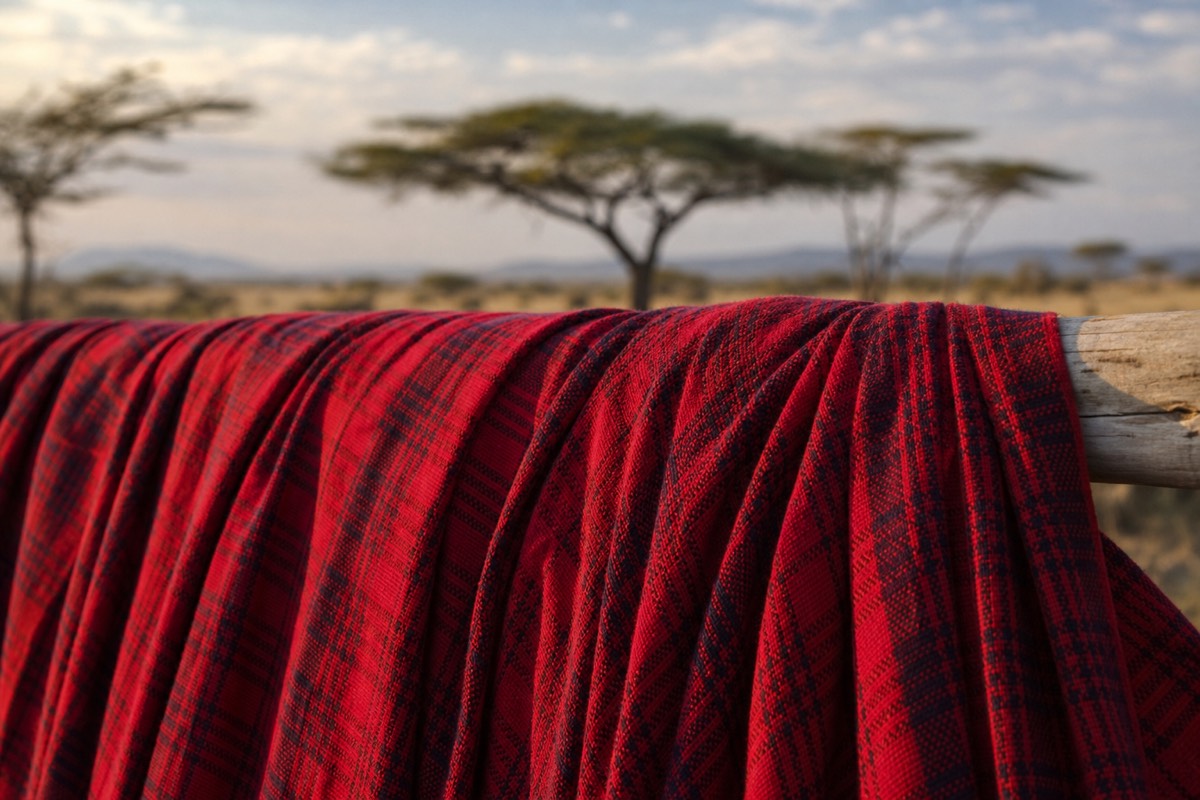
Ochre matters more than the cloth in the long view. Red earth pigment, mixed with fat, is worked into the hair and skin of morans and used to mark bodies and objects at ceremonies. When cotton trade goods arrived through the coast and moved inland during the nineteenth and early twentieth centuries, a red cloth slotted straight into a colour that already carried meaning, and it was warmer, cheaper and easier to replace than hide. Today the shuka is manufactured, much of it outside Kenya, and the plaid pattern has become a global shorthand for the community. That has been contested: a licensing body established in the community's name has spent years pressing international brands to pay for commercial use of Maasai imagery and the Maasai name, on the argument that a people should be able to license their own likeness the way a company licenses a logo.
The reasons usually given for red are visibility across long grass, a clear signal that the wearer is a person rather than prey, and an association with bravery and with the blood of cattle. Those are the explanations Maasai people give when asked. They are cultural reasoning, not tested biology, and we have not found a source that would let us state a predator-vision mechanism as fact, so we are not going to imply one.
Can I Wear Red In Kenya?
Yes. Red is not restricted, not taboo and not unlucky in Kenya. Maasai men and women wear it every day of the week, and nobody reads a red shirt on a visitor as an insult. The only clothing rule with actual legal force is the ban on military-pattern camouflage. On a game drive, guides prefer muted colours for a reason that has nothing to do with culture.
Two separate questions get tangled together here, and separating them answers both. The cultural question is whether red offends anybody. It does not. If anything, turning up in a red shuka bought at a market will get you gentle amusement rather than offence, and plenty of camps sell them. The field-craft question is different: in an open-roofed vehicle with the sun behind you, a block of saturated colour moving above the roofline is a high-contrast shape against a background of dry grass. Guides prefer khaki, olive, tan and stone because those disappear into the same background, which matters at close range with a skittish animal and matters not at all when you are driving between sightings.
So: red is culturally fine, mildly unhelpful at twenty metres from a leopard, and completely fine everywhere else. White is the colour most travellers regret, because it shows Mara dust inside the first hour of a game drive. Camouflage clothing is the one to leave at home outright, because it is illegal for civilians in Kenya and confiscation at the airport is a real outcome rather than a scare story. The full breakdown, including the biting-fly reason to avoid dark blue and black, sits in our guide to what to wear on a Kenya safari.
What Does The Beadwork Actually Say?
Beadwork is women's work, made and worn as a running record of status: married or not, initiated or not, celebrating or mourning, which family, which section. Colour readings are broadly consistent across the community but they are not a fixed code, and the meanings below are the ones beading groups most commonly give rather than a dictionary.
Glass beads arrived through the same trade routes as the cotton. Before them, ornaments were made from clay, shell, seeds, bone, wood and hammered copper and iron wire, and some of that older vocabulary survives in the metal coils worn on the upper arm. What did not change is who makes it. Beading is done by women, in groups, over long periods, and it is one of the few parts of the household economy that converts directly into cash. That is why the blanket of jewellery at the end of a homestead visit is not an afterthought bolted on for tourists. For many families it is the point of receiving visitors at all.
The showpiece is the enkarewa, the wide flat disc collar worn by women, built in concentric rings on a stiff base. It is engineered to move: when the wearer bounces on the balls of her feet during a song, the collar rises and falls on its own beat, and the visual rhythm of that is the women's counterpart to the men's jumping. Married women's ornament is heavier and more layered than an unmarried girl's, and a woman's wedding collar is usually the most elaborate single object in a household.
| Colour | Reading usually given | Where you notice it |
|---|---|---|
| Red | Bravery, unity, and the blood of the cattle | The dominant field colour in most collars and the shuka itself |
| White | Peace and purity, and milk, which is the same idea in a herding economy | Broad separating bands between colour rings |
| Blue | The sky, and rain, and by extension Enkai | Common in the outer rings of a collar |
| Green | Grazing, land, health of the herd | Narrow accent lines |
| Orange and yellow | Hospitality and warmth, associated with the gourds used to serve visitors | Earrings, bracelets, smaller pieces |
| Black | The people themselves and the hardship they endure | Fine outlining, rarely a field colour |
If you plan to buy something, buy it from the blanket in the homestead or from a named women's group rather than from a curio stall on the roadside, where a good deal of what is sold is factory work from elsewhere. Ask what the piece is for. You will usually get a straight answer, and the answer is more interesting than the object.
Why Does Everything Come Back To Cattle?
Cattle are the currency, the pantry, the insurance policy and the social record. A herd is not a business asset that a family happens to own; it is the thing marriages, fines, alliances and reputations are settled in. That is why drought is not an inconvenience in Maasai country. It is a solvency event.
The founding account most often told is that Enkai gave all the cattle in the world to the Maasai, which historically supplied the moral basis for taking cattle back from anyone else who had them. Raiding is long gone as an institution, but the underlying logic, that the herd is the measure of a household, has not moved. Herd size functions as a ledger of past marriages, past droughts, past generosity and past debts, which is why asking a man how many cattle he owns is a slightly indelicate question rather than a neutral one.
The famous part, drinking blood, is real and routinely over-dramatised for visitors. Blood is drawn from a blocked arrow shot into the jugular of a living animal, the wound is sealed, the animal walks away, and the blood is mixed with milk. It is not a daily meal. It is concentrated nutrition for the sick, for women after childbirth, for men recovering from circumcision, and for ceremonies. Meat is likewise ceremonial and elder-controlled rather than everyday, which is exactly why the ceremony that closes an age-set is literally named for eating meat.
| What the herd provides | How it is used | The detail people get wrong |
|---|---|---|
| Milk | The daily staple, often soured, stored in gourds treated with charcoal | This, not blood, is what people actually live on |
| Blood | Mixed with milk for the sick, new mothers, and ceremonies | The animal is not killed. A blocked arrow opens the jugular and the wound is closed afterwards |
| Meat | Ceremonial and controlled by elders | Olng'esherr, the ceremony that ends moranism, is the meat-eating ceremony |
| Hide | Bedding, sandals, straps, historically clothing | Leather dress predates the cotton shuka entirely |
| Dung | Mixed with mud and ash to plaster house walls | It sets hard, sheds rain and does not smell once cured |
| The animal itself | Bridewealth, fines, alliance-building, drought reserve | Herd size is a social record more than a bank balance |
What Is A Maasai Village Actually Called?
A family homestead is an enkang, usually called a boma in Kenyan English: a ring of houses inside a dense thorn fence, with livestock brought into the middle at night. A manyatta is specifically a warriors' settlement. Almost every "manyatta visit" sold to travellers is, strictly speaking, an enkang visit.
The layout is defensive and it is legible once you know what you are looking at. The outer fence is cut thorn scrub, packed tight and high enough to stop a hyena working through it. The houses sit around the inside edge, doorways facing inward. The open middle is the stock pen, and everything is arranged so that a family can get its animals inside and closed up before dark. Position within the ring is not random either; a man's houses sit in an order that reflects the seniority of each wife.
The houses are built by women, over roughly a month, from a frame of flexible timber lashed together and packed with a mixture of mud, grass, ash and cattle dung. The result is a low, dark, cool room with a fire in it, a smoke hole rather than a chimney, sleeping platforms, and often a calf pen inside for young animals that would not survive the night out. The doorway is deliberately low and set in a short curved entry passage, which keeps weather, light and flies out. You will duck. That is the design working.
What Happens On A Maasai Village Visit, And What Does It Cost?
Expect forty-five to ninety minutes: a greeting song at the gate, the jumping, a fire-making demonstration, a walk inside one house, and beadwork at the end. On the tours we list, the visit is almost always optional and priced separately, commonly around $20 to $50 per person, paid to the homestead. Our own cost guidance across the site puts it in that band.
The fee is the part travellers ask about most and the part it helps to be relaxed about. It is not a scam and it is not a tip. It is the agreed price of admitting a group of strangers into a working household, and it is usually collected once for the group and shared out. Some listings fold it in: the day trip that pairs the reserve with a Maasai village includes the village introduction fee in the ticket, and the four-day mid-luxury Mara and Lake Nakuru safari lists the cultural visit as complimentary. Others keep it as a clean add-on, such as the two-day private 4WD safari from Nairobi, whose own listing quotes $20 for the visit.
Where the visit lands in your itinerary matters more than the price. On a short trip it competes directly with prime wildlife hours, and our three-day Maasai Mara itinerary is blunt about the fix: put the homestead visit on a second afternoon, never on the final morning, because the last morning is a game drive you cannot get back. On longer trips the pressure disappears entirely and you can take the visit at a civilised hour.
How Should You Behave In Someone's Homestead?
Treat it as a house, not an attraction. Greet people before photographing them, ask before going through a doorway, keep your hands off livestock and children, and buy something at the end if you can. None of this is complicated and all of it changes the temperature of the hour completely.
The single biggest improvement most visitors can make is to slow down and ask questions through the guide. A homestead visit that consists of forty minutes of camera work feels transactional to everyone involved, including you. A homestead visit where you ask how long the house took to build, who built it, what the calf is doing indoors and what happens to the herd in a bad year turns into a conversation, and the family will usually meet you more than halfway.
| Do | Do not | Why it matters |
|---|---|---|
| Greet first, shoot second. A hand raised and a question asked takes five seconds | Photograph faces, especially children, before anyone has acknowledged you | Our own homepage guidance says the same: always ask before photographing people |
| Ask before stepping into a house | Walk into an inkajijik because the door is open | It is someone's bedroom, and often someone is in it |
| Dress as you would for any other village: shoulders and knees covered | Arrive in swimwear or very short shorts straight off a pool deck | Modesty norms in rural Kenya are stricter than in a camp |
| Buy from the blanket if the work appeals to you | Haggle a beaded collar down to nothing as sport | This is the part of the visit that actually reaches the women who did the work |
| Hand the fee through the guide or the elder | Distribute cash or sweets to individual children | It undercuts the household distribution and creates a begging dynamic that harms the next visitor |
| Say yes if invited to jump | Join the semicircle uninvited and start filming from inside it | Participation is welcome. Occupying the middle of a ceremony is not |
How Does Mara Tourism Money Reach Maasai Families?
Through land leases, mostly. The conservancies that ring the national reserve are private Maasai land pooled together and leased to a limited number of camps, with a monthly payment going directly to each landowning family. The umbrella body for these areas reports 24 conservancies across 178,668 acres involving 16,530 landowner families and around 50 tourism partners.
Those figures come from the Maasai Mara Wildlife Conservancies Association, the association the conservancies themselves sit under, and they are the clearest single answer to the question of whether safari money reaches households. A conservancy lease is a monthly rent per acre, paid to a named family, in exchange for keeping that parcel unfenced, uncultivated and lightly stocked. The family retains title. The camp gets exclusive traversing rights and a hard cap on how many beds and vehicles may operate on the land. The wildlife gets a corridor that would otherwise have been subdivided into farm plots.
Employment is the second channel and a large one: guiding, tracking, camp work, and the ranger and scout units. The Mara Conservancy, the non-profit that runs the Mara Triangle in the west of the reserve, reports 4,500 poachers arrested over 16 years and 57,000 wire snares removed, work done by ranger teams and by community scouts along the Siria Escarpment. That is a payroll as much as a conservation statistic. If the structural side of this interests you, we go through it properly in our guide to how the Mara's private conservancies work, including which lodge styles pair with which conservancy and what the extra daily fee buys.
Which Safaris Actually Include A Maasai Village Visit?
Most Mara itineraries offer one, but the terms differ: some include the fee, some price it separately, and a handful build the cultural element into the route rather than bolting it on. The table below is drawn from the listings of the tours we work with, not from a generic assumption that every safari has a village stop.
| Tour | How the village element is handled | From |
|---|---|---|
| From Nairobi: Maasai Mara Reserve & Maasai Village Day Trip | Village introduction fees included in the ticket; a long single day with a 4:30am start | $180 |
| Maasai Mara & Lake Nakuru: 4-Day Mid-Luxury Experience | Listed as a complimentary cultural visit, taken as an afternoon walk from the lodge | $1,400 |
| Maasai Mara & Nakuru: 4-Day Group Safari Adventure | Optional visit on the third morning, before the transfer to Lake Nakuru | $840 |
| Hassle-Free 12-Day Masai Mara & Gorilla Safari Adventure | Village visit offered as an alternative to the dawn balloon flight, inside a long East Africa route | $6,999 |
| Private Safari to Maasai Mara & Amboseli: 7-Day Tour | Optional Maasai walk rather than a set-piece homestead visit | $3,450 |
| 2-Day/1-Night Private Maasai Mara from Nairobi in 4WD | Optional, quoted at $20 per person on the listing, and explicitly not mandatory | $400 |
Prices are the current online starting rates and shift with season and group size, so treat them as orientation and check the live listing for your dates. If you are still deciding between a short road trip and something longer, our breakdown of how long you actually need in the Mara is the place to start, and the real cost of a Maasai Mara safari covers what sits outside the package price.
What The Tourist Version Leaves Out
Three things, mostly: that this is a community under real economic strain, that a large share of Maasai life now looks like everybody else's, and that the performance you see is a deliberate, negotiated compromise rather than a survival of the past in amber.
Land subdivision has broken large communal grazing areas into individual parcels, which is what made conservancy leases possible and also what makes the herding cycle harder to run. Drought years hit herds directly, and the UNESCO listing itself names cattle loss as one of the reasons the ceremonies are performed less. Many Maasai families now farm, run shops, drive matatus, teach, and send children to boarding school in Narok. Mobile money moves the lease payments. None of that makes the culture less real, and a visitor who expects a community frozen in the nineteenth century will misread almost everything in front of them.
The homestead visit, seen straight, is a household deciding that admitting strangers for an hour is a reasonable way to convert its location into income, on terms it sets. That is a fairly dignified arrangement. It works best when the visitor treats it as such: shows up curious, asks real questions, pays the agreed fee without theatre, and leaves. The families that host well are extremely good at it, and an hour done properly will teach you more about why the plain looks the way it does than a week of game drives.